Step by Step Guide to Painting Your Home Exterior Yourself
Reading time: 14 minutes
Ever stared at your home’s peeling, faded exterior and thought, “I should just hire someone” — then got a contractor quote and immediately reconsidered? You’re not alone. In 2026, the average cost of professional exterior painting for a mid-sized home sits between $4,500 and $9,000, depending on your region and surface area. That’s a significant investment — and for many homeowners, it’s one they can reclaim by doing the job themselves.
Here’s the real talk: exterior painting isn’t just about slapping color on siding. It’s a structured project that demands preparation, the right materials, and a clear game plan. Done right, a DIY exterior paint job can last 8–12 years, dramatically boost curb appeal, and increase your home’s resale value by up to 5%, according to a 2025 National Association of Realtors report.
This guide walks you through every stage — from assessing your exterior to applying that final coat — with practical steps, real-world examples, and expert-backed advice. Whether you’re a first-timer or someone who’s tackled interior rooms before, this is your roadmap.
Table of Contents
- Why DIY Exterior Painting Makes Sense in 2026
- Phase 1: Planning & Assessment
- Phase 2: Tools, Materials & Paint Selection
- Phase 3: Surface Preparation (The Most Critical Step)
- Phase 4: Priming for a Long-Lasting Finish
- Phase 5: The Painting Process Step by Step
- Common Challenges & How to Overcome Them
- Paint Types Compared: What Works Best Where
- Frequently Asked Questions
- Your Exterior Transformation Checklist: Ready to Roll
Why DIY Exterior Painting Makes Sense in 2026
The home improvement landscape has shifted significantly. Material costs have stabilized after the supply chain disruptions of the early 2020s, and product quality — particularly in paints and primers — has improved dramatically. In 2026, premium exterior paints with built-in primer, mildew resistance, and UV protection are widely available at major retailers for $45–$80 per gallon. That’s a fraction of what you’d pay in labor costs.
Consider this quick scenario: Marcus, a homeowner in Atlanta with a 1,800 sq ft colonial-style home, received three contractor quotes in early 2026 ranging from $5,200 to $7,800. After researching materials and investing a single weekend in preparation and two weekends in painting, he completed the job for approximately $1,100 in materials — and reported higher satisfaction because he chose exactly the finish he wanted. His story isn’t exceptional; it’s increasingly common.
Key reasons homeowners are choosing DIY in 2026:
- Labor cost savings of 60–75% compared to professional services
- Greater control over color selection, finish, and quality of materials
- Access to instructional content (video tutorials, manufacturer guides) now more robust than ever
- Improved paint formulations that are more forgiving for non-professionals
- Flexible scheduling — work at your own pace across multiple weekends
Phase 1: Planning & Assessment
Inspecting Your Exterior Before You Buy a Single Brush
The single biggest mistake DIYers make is rushing to the paint store before properly assessing their home’s current condition. Your preparation needs will vary enormously depending on what you find.
Walk the full perimeter of your home and look for:
- Peeling or bubbling paint — indicates moisture intrusion or adhesion failure
- Chalking — a powdery residue on older painted surfaces that requires cleaning before repainting
- Cracks or gaps in siding, trim, or around windows and doors
- Wood rot — soft, discolored, or spongy wood needs repair or replacement before painting
- Mold or mildew — appears as dark stains, particularly on shaded or damp-facing walls
- Rust stains near metal hardware or flashing
Document everything with your phone camera. This visual inventory becomes your repair checklist and helps you estimate material quantities accurately.
Calculating How Much Paint You’ll Need
Underestimating paint quantity is a classic beginner error that leads to color-matching nightmares mid-project. Here’s a reliable formula:
Step 1: Calculate the total wall area. Multiply the perimeter of your home by the average wall height. For a home with a 180-foot perimeter and 9-foot walls, that’s 1,620 sq ft of wall surface.
Step 2: Subtract large openings. Deduct approximately 20 sq ft per standard window and 21 sq ft per door.
Step 3: Account for coverage. One gallon of quality exterior paint covers roughly 350–400 sq ft per coat. For most homes, plan for two coats.
Step 4: Add 10–15% overage for touch-ups, waste, and uneven surfaces.
Pro Tip: Always buy paint from the same batch (same lot number) to ensure consistent color. Mix all cans of the same color together in a large bucket — a process called “boxing” — before you begin painting.
Phase 2: Tools, Materials & Paint Selection
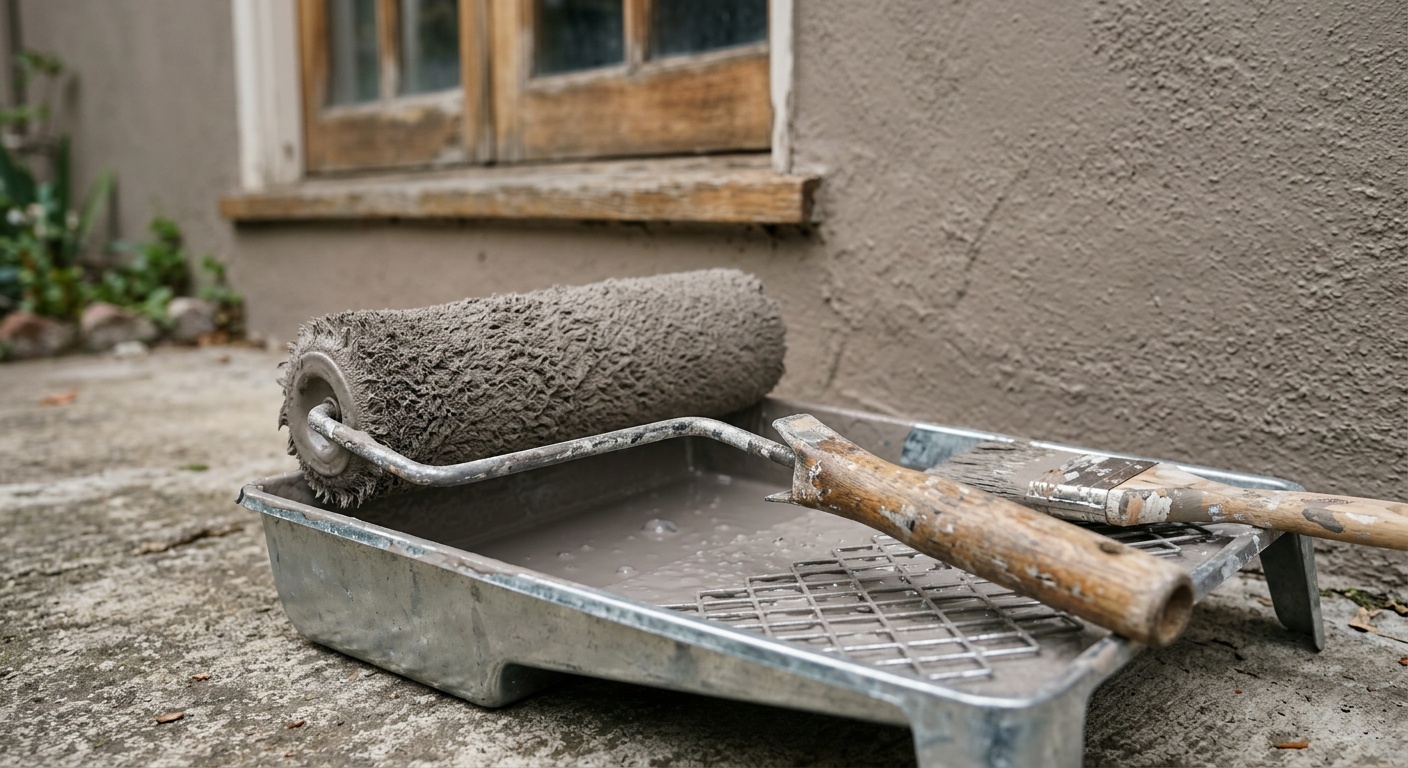
Investing in quality tools isn’t just about convenience — it directly impacts your final result. A cheap brush leaves streaks. An inadequate sprayer creates overspray disasters. Here’s what a well-equipped DIY exterior painter needs in 2026:
Essential Tools Checklist
- Pressure washer (rent one for $60–$90/day if you don’t own one)
- Extension ladder (fiberglass recommended for safety near power lines)
- Paintbrushes: 4-inch angled sash brush for trim, 2.5-inch brush for detail work
- 9-inch roller frames with extension poles (at least 6-foot extension)
- 3/4-inch nap roller covers for rough surfaces; 3/8-inch for smooth surfaces
- Paint sprayer (optional but speeds up large flat areas significantly)
- 5-in-1 painter’s tool for scraping and surface prep
- Caulking gun and exterior-grade paintable caulk
- Drop cloths and plastic sheeting (canvas is better than plastic for ground coverage)
- Painter’s tape (Frog Tape and 3M ScotchBlue are top performers in 2026)
- Sandpaper (80-grit for rough areas, 120-grit for smoother sanding)
- Putty or wood filler for gaps and cracks
- Safety glasses, respirator mask (N95 minimum), and work gloves
Choosing the Right Paint for Your Climate and Surface
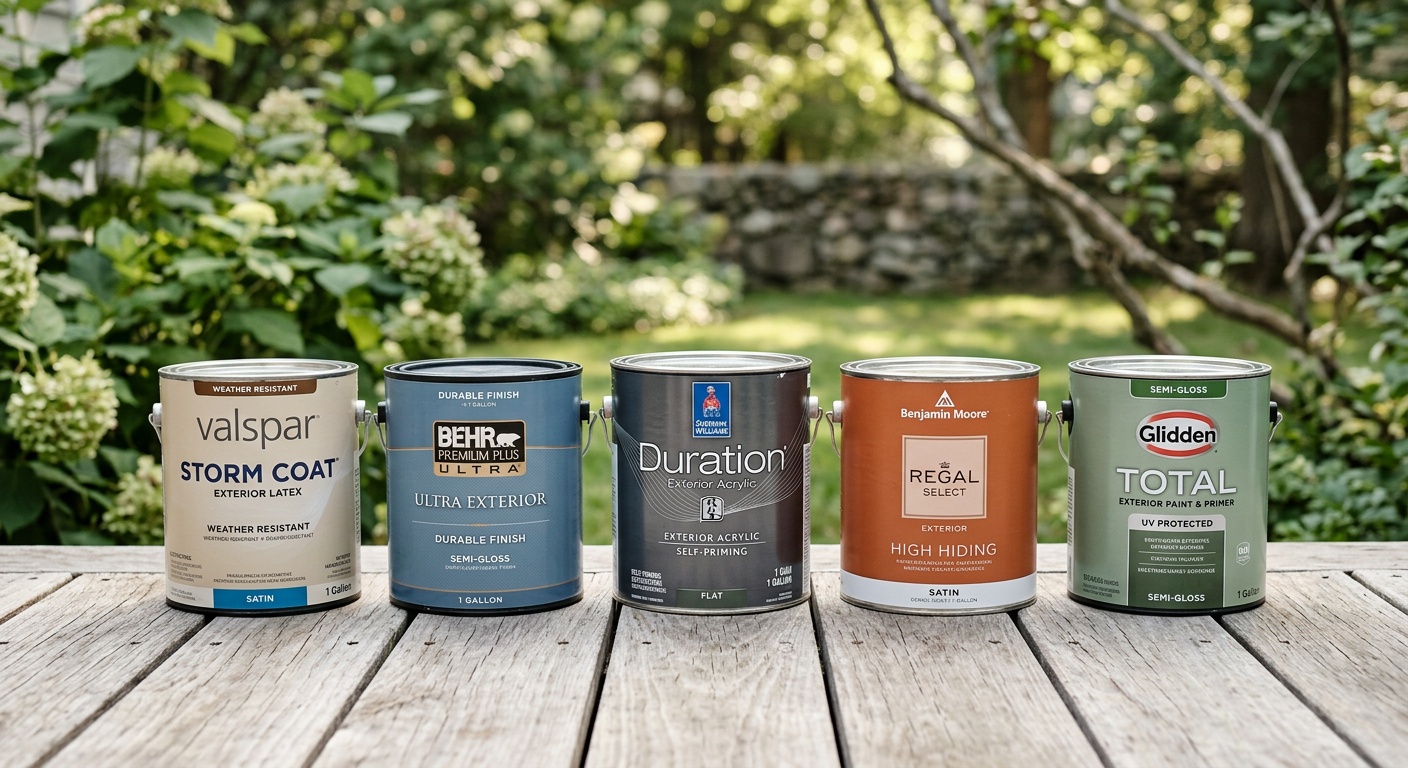
Not all exterior paints are created equal, and the “best” product genuinely depends on your regional climate and surface material. In 2026, the market leaders consistently recognized by consumer testing organizations are acrylic-latex formulations — and for good reason.
100% Acrylic Latex Paint is the go-to recommendation for most surfaces and climates. It flexes with temperature changes, resists mildew, cleans up with water, and maintains color vibrancy for a decade or longer when properly applied. Brands like Sherwin-Williams Emerald Exterior, Benjamin Moore Aura Exterior, and Behr Premium Plus Ultra consistently earn top marks.
Oil-based paints have become increasingly niche in 2026. Stricter VOC regulations in many states have limited their availability, and their longer dry times make them impractical for most DIYers. They’re occasionally preferred for metal surfaces and high-gloss trim work.
Elastomeric coatings are worth considering for stucco, concrete, or masonry surfaces with existing hairline cracks. These thick, rubber-like coatings bridge minor cracks and provide exceptional waterproofing — though they require specific application techniques.
Phase 3: Surface Preparation (The Most Critical Step)
Ask any professional painter what separates a paint job that lasts 10 years from one that fails in three, and they’ll say the same thing: preparation. This phase accounts for roughly 70% of the total effort and deserves the most attention.
Power Washing: Starting with a Clean Canvas
Begin by thoroughly washing all painted surfaces. Use a pressure washer set to 1,500–2,000 PSI for wood siding (higher pressure risks gouging the wood) and up to 2,500 PSI for masonry. Use a 25-degree fan tip nozzle for general washing and a 40-degree tip near sensitive areas.
For homes with visible mold or mildew, add a cleaning solution. Mix one part household bleach with three parts water, apply with a garden sprayer, let it sit for 15 minutes, then pressure wash clean. Always wear eye protection and rubber gloves during this step.
Critical insight: Allow the surface to dry completely — typically 48–72 hours in warm, sunny weather — before proceeding. Painting over damp wood is one of the leading causes of paint failure.
Scraping, Sanding, and Repairing Surfaces
Once dry, remove all loose or peeling paint with a paint scraper and wire brush. For large areas, a heat gun or infrared paint remover speeds up the process significantly without damaging the substrate. Avoid chemical strippers on large exterior areas — they’re messy and time-consuming.
Sand all scraped areas smooth with 80-grit sandpaper, then follow with 120-grit to feather the edges between bare wood and existing paint. Feathering creates a seamless transition so the new paint coat doesn’t highlight “steps” in the surface.
Fill all cracks, nail holes, and gaps with appropriate filler:
- Exterior wood filler (epoxy-based) for structural holes and rot-damaged areas
- Paintable exterior caulk for gaps at joints, around windows, and where trim meets siding
- Hydraulic cement for cracks in masonry or concrete foundations
Allow all fillers and caulks to cure per manufacturer instructions before sanding smooth and priming. This step feels tedious — but it’s what separates a professional-looking result from an amateur one.
Phase 4: Priming for a Long-Lasting Finish
Primer is the unsung hero of any paint job. It improves adhesion, blocks stains, prevents tannin bleed-through (common in cedar and redwood siding), and creates a uniform base that allows your topcoat to look its best with fewer coats.
In 2026, when to prime and when to skip it is clearer than ever:
- Always prime bare wood, repaired areas, and surfaces where old paint was removed down to substrate
- Always prime when making a dramatic color change (e.g., dark to light)
- Always prime stucco, masonry, and new surfaces never previously painted
- You may skip priming when repainting a sound, lightly faded surface with a paint-and-primer-in-one product in a similar color
Apply primer with a brush for edges and detailed areas first (this technique is called “cutting in”), then use a roller for flat surfaces. One coat of quality exterior primer is usually sufficient. Allow it to dry fully — typically 4–6 hours for latex primers — before topcoating.
Real-world example: Jennifer, a homeowner in Portland, Oregon, attempted to skip priming on her cedar-sided craftsman bungalow when repainting in 2025. Within six months, she noticed dark reddish-brown stains bleeding through her light gray topcoat — classic tannin bleed from the cedar. She had to sand, re-prime with a stain-blocking oil-based primer, and repaint. The lesson cost her an extra $200 and an entire weekend.
Phase 5: The Painting Process Step by Step
With your surface prepped and primed, you’re ready for the most rewarding phase. Follow this sequence for a clean, professional result:
The Right Order: Top to Bottom, Edges to Fields
Step 1 — Protect everything you’re not painting. Cover windows, lighting fixtures, outlets, plants, and the ground with drop cloths and plastic sheeting secured with painter’s tape. Take your time here; tape pulls clean paint if you rush removal, and drips on concrete are difficult to remove.
Step 2 — Paint the fascia and soffits first. These are the boards under the roofline. Working top to bottom prevents drips from contaminating finished surfaces below.
Step 3 — Paint window and door trim next. Use your 2.5-inch angled brush. Apply with smooth, continuous strokes along the grain of the wood. Two thin coats beat one thick coat every time.
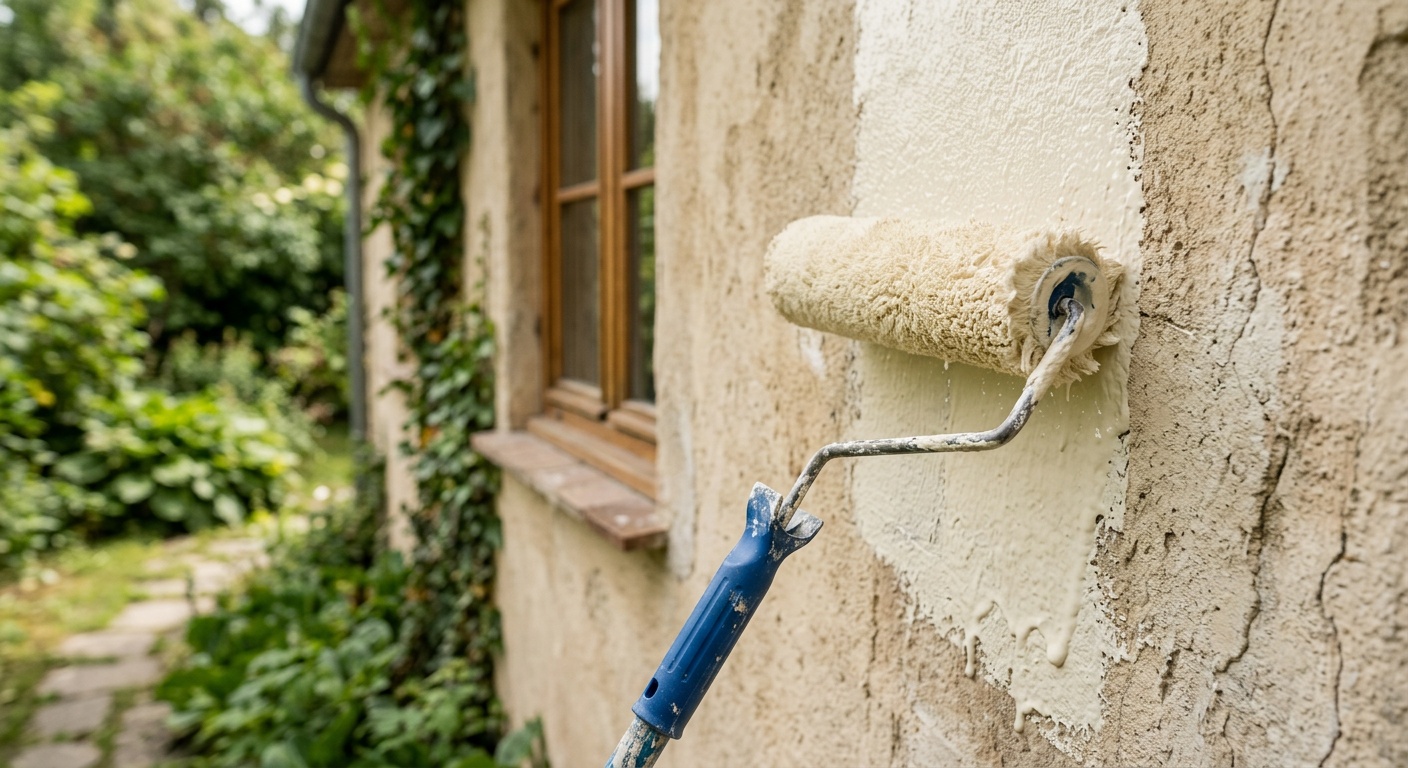
Step 4 — Paint the main body (siding). Work in manageable sections — typically one wall at a time. If using a roller, cut in the edges with a brush first, then fill the field with the roller. Maintain a “wet edge” by overlapping each new stroke into the previous one while it’s still wet. This prevents lap marks.
Step 5 — Paint the shutters and accent pieces last. These can be removed and painted separately for cleaner results, or painted in place.
Weather Windows: When to Paint and When to Wait
Exterior painting is weather-dependent in ways that interior work isn’t. The ideal conditions for applying exterior latex paint in 2026 remain consistent with manufacturer guidelines:
- Temperature: Between 50°F (10°C) and 85°F (29°C), both ambient and surface temperature
- Humidity: Below 85% relative humidity
- Wind: Minimal — strong wind causes paint to dry too quickly and carries debris into wet surfaces
- No rain forecast for at least 24 hours after application
- Avoid direct sunlight on the surface being painted — follow the shade around your house
Early morning is often the best time to begin, as surfaces are cool and dew has evaporated. In summer, many experienced DIYers start at 7 AM and pause during peak afternoon heat.
Common Challenges & How to Overcome Them
Challenge 1: Paint Won’t Adhere to Glossy Old Paint
If the existing paint has a high-gloss finish, new paint may bead or peel because it has nothing to grip. The fix is simple: lightly sand all glossy surfaces with 120-grit sandpaper to dull the sheen, then wipe down with a tack cloth before priming. You can also use a liquid deglosser product — apply with a cloth and allow to dry. These chemical dullers are faster than sanding large areas.
Challenge 2: Lap Marks and Streaking on Siding
Lap marks occur when you paint over a section that has already begun to dry. On hot or windy days, this can happen surprisingly fast. To prevent them: work in smaller sections, maintain a wet edge at all times, and use a paint additive like Floetrol for latex paints in challenging weather. Floetrol extends the open (wet) time of your paint, giving you more time to blend sections smoothly.
Challenge 3: Managing Multi-Story Heights Safely
Height is the most legitimate concern for DIY exterior painting. A 24-foot extension ladder is sufficient for most two-story homes, but ladder safety protocols are non-negotiable. Always maintain three points of contact. Never overreach — move the ladder instead. On uneven ground, use ladder levelers. For second-story gables and peaks, consider renting a pump jack scaffold or a pump-up work platform, which provides a stable work surface far safer than an overextended ladder.
Note: In 2026, several municipalities in California, New York, and Washington State have tightened residential ladder safety codes for DIYers working above 15 feet. Check your local building code before beginning work.
Paint Types Compared: What Works Best Where
| Paint Type | Best Surface | Durability | Avg Cost/Gallon (2026) | DIY Friendly? |
|---|---|---|---|---|
| 100% Acrylic Latex | Wood, fiber cement, vinyl | 8–12 years | $50–$80 | ✅ Yes — highly recommended |
| Oil-Based Alkyd | Metal, high-gloss trim | 6–10 years | $55–$90 | ⚠️ Limited — VOC restrictions |
| Elastomeric Coating | Stucco, masonry, concrete | 10–15 years | $60–$95 | ⚠️ Moderate — technique matters |
| Solid Stain | Rough-sawn or weathered wood | 4–7 years | $40–$65 | ✅ Yes — very forgiving |
| Paint-and-Primer-in-One | Most surfaces (repaints) | 7–10 years | $55–$85 | ✅ Yes — best for repaints |
DIY Exterior Painting: Cost Savings Visual Overview
The chart below illustrates where your DIY savings are most significant when comparing typical costs for a 1,800 sq ft home in 2026:
*Approximate values for a 1,800 sq ft home, 2026 national averages. Labor cost represents mid-range professional quote.
Frequently Asked Questions
How long does a DIY exterior painting project typically take for an average-sized home?
For a typical 1,500–2,000 sq ft single-story or two-story home, most DIYers complete the full project across 3–5 weekends. Preparation (washing, scraping, caulking, priming) generally takes as long as the painting itself — sometimes longer. First-time painters should budget conservatively. If you rush the prep phase to save time, you’ll likely compromise the final result and longevity. Setting a relaxed timeline of 4–6 weekends with flexibility for weather delays is a realistic and stress-reducing approach.
Is it worth using a paint sprayer instead of brushes and rollers for exterior work?
A paint sprayer can cover large flat surfaces like siding significantly faster, but it requires masking absolutely everything you don’t want painted — windows, trim, plants, driveways, neighboring surfaces. For homes with complex architectural detail, the masking time often cancels out the application speed advantage. The hybrid approach most experienced DIYers use in 2026 is: spray the main body siding on large flat walls, then cut in all edges, trim, windows, and doors with brushes. This captures the speed benefits of spraying while maintaining precision where it counts. If you’ve never used a sprayer, practice on cardboard first to get the feel of distance, speed, and overlap.
How do I know when my exterior paint truly needs replacing versus just cleaning?
This is one of the most common questions homeowners ask, and the answer comes down to what you find during your inspection. Cleaning and refreshing is sufficient when the paint is intact, adhesion is solid, and discoloration is primarily due to dirt, algae, or chalking. A good pressure wash and possibly a fresh topcoat in the same color may be all you need. Full repainting is warranted when you find widespread peeling, flaking paint that fails the “tape test” (press tape firmly on the surface; if paint comes off when you pull it, adhesion has failed), visible bare wood, or color fading so severe that a topcoat won’t restore an even appearance. As a general rule, most quality exterior paint jobs in climates with moderate weather cycles last 8–10 years before requiring full repainting.
Your Exterior Transformation Checklist: Ready to Roll
You now have the full blueprint. Exterior painting is one of the highest-ROI home improvement projects available to homeowners in 2026, combining meaningful cost savings with a genuinely transformative visual result. The difference between a DIY job that disappoints and one that delights comes down to one thing: systematic execution.
Here’s your practical checklist for immediate action:
- ✅ Week 1: Conduct a full exterior inspection, photograph problem areas, and create your materials list and budget
- ✅ Week 2: Purchase materials, rent a pressure washer, power wash the entire exterior, and allow 48–72 hours to dry fully
- ✅ Week 3: Complete all scraping, sanding, wood filler application, and caulking; apply primer to bare and repaired areas
- ✅ Week 4: Apply first topcoat in optimal weather conditions, working top to bottom and maintaining a wet edge
- ✅ Week 5: Apply second topcoat, paint trim and accents, remove masking, and complete touch-ups
Beyond the immediate project, consider this broader trend: as AI-powered color visualization tools and augmented reality apps become standard in 2026 — Sherwin-Williams’ ColorSnap AR, Benjamin Moore’s Color Portfolio app — homeowners have more creative confidence than ever when choosing exterior palettes. The technology that once helped only design professionals is now in your pocket.
Your home is likely your most significant financial asset. Protecting and enhancing it with a well-executed exterior paint job isn’t just a cosmetic choice — it’s a strategic one. So here’s the question worth sitting with: What’s the real cost of waiting another year while your exterior continues to weather, fade, and invite moisture damage? Your brushes are ready. Your checklist is set. The best time to start was last year. The second-best time is this weekend.