Exterior Mobile Home Renovation Paint Ideas That Last
Reading time: 14 minutes
Here’s a scenario most mobile homeowners know all too well: You spend a weekend painting your exterior, feeling proud of the transformation — only to watch the finish blister, peel, and fade within eighteen months. Frustrating? Absolutely. Avoidable? One hundred percent.
The truth is, painting a mobile home exterior isn’t the same as painting a traditional stick-built house. The materials are different, the movement dynamics are different, and the stakes for choosing the wrong product are much higher. But with the right strategy, an exterior paint job can last a decade or more — and dramatically boost your home’s curb appeal and resale value in the process.
In 2026, mobile home communities across the U.S. are seeing a design renaissance. According to the Manufactured Housing Institute, over 22 million Americans live in manufactured or mobile homes, and renovation spending in this segment grew by 18% between 2024 and 2026. Exterior painting is consistently ranked as the top ROI renovation choice in this category. So let’s get this right — together.
Table of Contents
- Why Mobile Home Exteriors Demand a Different Approach
- Best Paint Types for Mobile Home Exteriors in 2026
- Color Ideas That Work and Last
- Surface Preparation: The Step Most People Skip
- Application Techniques That Extend Paint Life
- 3 Common Challenges and How to Overcome Them
- Paint Product Comparison Table
- Durability Data: How Paint Types Stack Up
- Frequently Asked Questions
- Your Exterior Renovation Roadmap: Next Steps
Why Mobile Home Exteriors Demand a Different Approach
Mobile homes — more accurately called manufactured homes for units built after the HUD Code of 1976 — are constructed with materials that behave very differently from wood-framed homes. The exterior walls are typically made of aluminum siding, vinyl siding, T1-11 wood composite panels, or fiber cement boards. Each of these substrates expands and contracts at different rates depending on temperature and humidity, creating a paint-adhesion nightmare if you’re using the wrong product.
Beyond substrate differences, mobile homes are often sited in locations — coastal areas, desert regions, or open plains — where UV exposure, wind, and moisture fluctuations are extreme. A paint formulated for a protected suburban bungalow simply won’t hold up on a manufactured home parked in the Arizona desert or the Gulf Coast of Louisiana.
The core challenge is threefold:
- Substrate flexibility and thermal movement
- High UV exposure in typical placement environments
- Limited surface thickness that makes moisture penetration dangerous
Understanding this context is the foundation of every good paint decision. Think of it as solving an engineering problem with aesthetic benefits, not just picking a pretty color from a swatch.
The Real Cost of Getting It Wrong
Let’s talk numbers. A basic exterior repaint for a single-wide mobile home costs between $800 and $2,500 in labor and materials as of 2026, depending on your region and the complexity of the job. If you choose the wrong paint and it fails within two years, you’re not just repainting — you’re also dealing with moisture damage, potential mold remediation, and structural repairs that can run $4,000 to $12,000. That’s a painful lesson in false economy.
Conversely, a properly executed exterior paint job using the right products can last 8 to 12 years, protect your home’s structural integrity, and add measurable value to your property. Mobile homes in well-maintained condition fetch 15–25% higher resale prices in current market conditions, according to 2025 data from the National Manufactured Housing Federation.
Best Paint Types for Mobile Home Exteriors in 2026
The paint market has evolved significantly. In 2026, you’re no longer choosing between “good enough” and “terrible.” You’re choosing between several high-performance options — but you need to match the right product to your specific substrate.
Elastomeric Paint: The Gold Standard for Longevity
If there’s one paint category that consistently outperforms the rest on mobile home exteriors, it’s elastomeric paint. This thick, rubber-like coating is specifically engineered to bridge hairline cracks and flex with the substrate as temperatures change. It creates a waterproof membrane rather than just a decorative surface.
Elastomeric coatings are 10 to 20 times thicker than standard latex paint — typically applied at 10–15 mils dry film thickness versus 1–2 mils for conventional exterior paint. Leading brands like DRYLOK Masonry Waterproofer, Sherwin-Williams Loxon, and Rust-Oleum’s RockSolid line offer elastomeric formulas that are well-suited for mobile home applications in 2026.
Best for: Aluminum siding, stucco-coated panels, older homes with small surface cracks
Expected lifespan: 10–15 years with proper prep
Cost per gallon: $45–$85
100% Acrylic Latex Paint: The Versatile Workhorse
For most mobile homeowners, a high-quality 100% acrylic latex exterior paint represents the sweet spot of performance, cost, and ease of application. Acrylic paint adheres well to most substrates, resists UV degradation, remains slightly flexible when cured, and cleans up with water.
Not all acrylic paints are equal, however. Look for formulas with UV-blocking pigments, mildew-resistant additives, and a satin or semi-gloss sheen — these characteristics dramatically extend service life. In 2026, premium acrylic formulas from Benjamin Moore Aura Exterior, Sherwin-Williams Duration, and Behr Marquee consistently earn top ratings in independent consumer testing.
Best for: Vinyl siding, wood composite panels, fiber cement
Expected lifespan: 7–10 years
Cost per gallon: $55–$75
Specialty Aluminum Siding Paints
Aluminum siding presents a unique challenge because paint doesn’t naturally bond to bare metal. If your mobile home has original aluminum siding, you need either a self-etching primer followed by acrylic topcoat, or a paint-and-primer-in-one formula specifically engineered for metal substrates. Products like Rust-Oleum Clean Metal Primer + Topcoat systems are formulated to chemically bond with aluminum rather than simply sitting on the surface.
Skip this step, and you’ll be peeling paint within a year — no matter how expensive your topcoat was.
Color Ideas That Work and Last
Color selection isn’t just an aesthetic decision — it directly impacts paint longevity and your home’s thermal efficiency. Here’s what the science and the design trends of 2026 both suggest.
Light and Warm Neutrals: Timeless and Thermally Smart
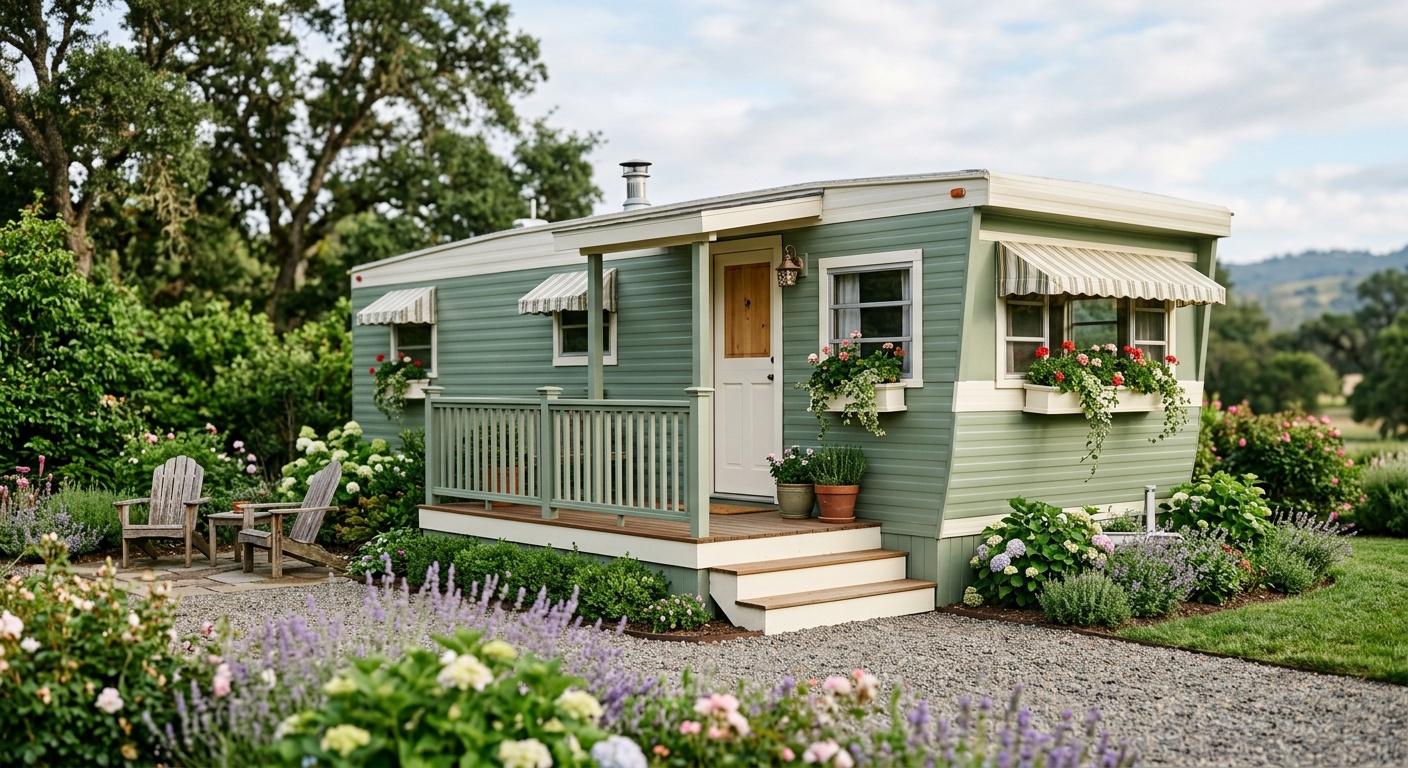
In climates with intense sun exposure — the Southwest, South, Southeast — lighter color palettes are both practical and popular. Light colors reflect rather than absorb solar radiation, reducing surface temperature and minimizing the expansion-contraction cycling that degrades paint over time. Warm whites, creamy beiges, soft sage greens, and pale grays are dominating mobile home renovation projects in 2026 and for good reason.
Consider: Alabaster (SW 7008), Accessible Beige (SW 7036), Pale Oak (BM OC-20), and Agreeable Gray (SW 7029) — all of these have proven staying power in both design trends and physical durability.
Bold Accents Without Full Commitment
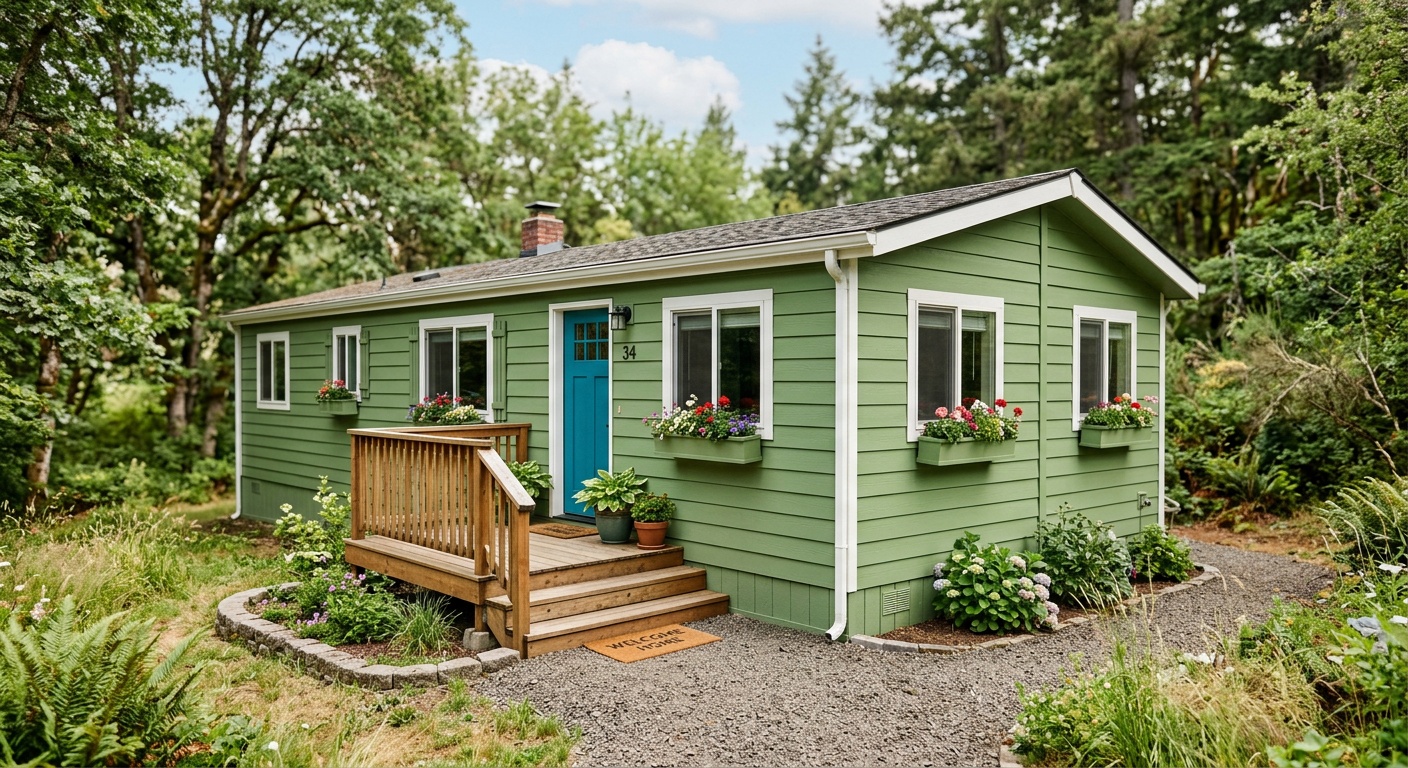
A growing 2026 trend is the two-tone exterior strategy: a neutral base for the main body paired with a more expressive color on trim, shutters, doors, and skirting. This approach lets homeowners express personality without committing to a bold full-body color that may feel dated in five years — or worse, violate HOA or community guidelines.
Popular accent combinations in 2026:
- Warm white body + Deep navy trim — Classic, clean, always current
- Greige body + Forest green door and shutters — Nature-connected, trending strongly
- Soft gray body + Terracotta or rust accents — Earthy, distinctive, photogenic
- Cream body + Black trim — Farmhouse-modern, high contrast, very popular
What to Avoid: Colors That Age Poorly
Avoid deep saturated colors as full-body choices in high-UV environments. Deep red, bright yellow, and royal blue contain organic pigments that fade dramatically faster than neutral tones. In 2025 testing by Consumer Reports, deep red exteriors in high-UV climates lost measurable color depth within 18 months even with premium paint. UV-inhibiting pigment technology has improved, but physics still wins over chemistry in extreme conditions.
Surface Preparation: The Step Most People Skip
Here’s the straight talk: 70% of exterior paint failures are caused by inadequate surface preparation, not inferior paint products. This is the most skipped and most important step in any mobile home exterior renovation.
Think of surface prep as the foundation of a building. No matter how beautiful your architectural choices are, a compromised foundation means everything above it eventually fails. The same logic applies to paint adhesion.
The Complete Prep Sequence
- Pressure washing: Use 1,500–2,000 PSI to remove dirt, chalking old paint, mold, and mildew. Work top to bottom, holding the nozzle at a 45-degree angle to avoid forcing water behind siding panels.
- Mildew treatment: Mix one part bleach to three parts water, apply with a brush or sprayer to any mildewed areas, let sit 10 minutes, then rinse thoroughly.
- Scraping and sanding: Remove all loose, flaking, or peeling existing paint. Sand rough edges to feather transitions. On aluminum, lightly sand or scuff the entire surface with 120-grit to improve adhesion.
- Caulking: Fill all gaps, seams, and cracks around windows, doors, vents, and panel joints with a flexible exterior caulk rated for at least 25 years. This is critical — uncaulked seams allow moisture infiltration that destroys paint from behind.
- Priming: Never skip primer on a mobile home. Match primer to substrate: bonding primer for aluminum, stain-blocking primer for wood composites, masonry primer for stucco panels. Let cure fully — typically 24 hours — before topcoating.
Quick Scenario: Imagine a homeowner in Tucson who spent $1,200 on premium elastomeric paint but skipped pressure washing because the siding “looked clean.” Within eight months, paint was peeling in sheets — not because of the paint, but because it bonded to a layer of chalky oxidation instead of the siding itself. A $50 pressure washing session would have saved the entire job.
Application Techniques That Extend Paint Life
Even with the right paint and perfect prep, application technique matters enormously for longevity.
Spray vs. Roll vs. Brush
Airless sprayer is the professional choice for mobile home exteriors because it delivers consistent film thickness across large flat surfaces and penetrates into corrugated or textured panels more effectively than rolling. It also completes the job faster, reducing the risk of weather interruptions mid-application.
If spraying isn’t practical, a 3/8-inch nap roller works well for smooth to lightly textured surfaces, followed by a brush to “back-brush” material into seams and edges. Avoid foam rollers — they create bubbles and uneven application on exterior surfaces.
Timing and Weather Windows
Temperature and humidity are non-negotiable factors. Apply exterior paint only when:
- Air and surface temperature is between 50°F and 90°F (10°C–32°C)
- Relative humidity is below 85%
- No rain is forecast for at least 24 hours after application
- Direct sunlight isn’t heating the surface above 95°F — paint applied to overheated surfaces dries too fast and develops poor adhesion
In most of the U.S., the ideal painting windows are mid-spring (April–May) and early fall (September–October).
Two Coats — Always
One coat is never sufficient for a mobile home exterior, regardless of what the paint label claims. The first coat seals the substrate and establishes the bond; the second coat provides the full film thickness needed for weather resistance and color depth. Allow the first coat to cure per the manufacturer’s instructions — typically 4–6 hours for acrylic latex — before applying the second.
3 Common Challenges and How to Overcome Them
Challenge 1: Paint Won’t Adhere to Old Aluminum Siding
The problem: Aluminum develops a microscopic oxide layer that repels paint. Standard exterior primers and paints simply won’t stick long-term without addressing this layer.
The solution: Use a self-etching primer (also called an acid-wash primer) that chemically dissolves the oxide layer and creates a molecular bond with the metal. Apply it to thoroughly cleaned and dried aluminum, let cure 1–2 hours, then prime again with a standard bonding primer before topcoating. This two-primer approach sounds excessive but adds years to the paint life.
Challenge 2: Bubbling or Blistering Paint
The problem: Paint blisters almost always indicate moisture — either moisture trapped in or behind the substrate, or paint applied over a damp surface. This is particularly common in humid climates or when painting too soon after washing.
The solution: After pressure washing, allow at least 48–72 hours of dry weather before painting. In humid climates, check moisture content with a moisture meter — substrate moisture should be below 15% for wood composites. If blistering exists on a current paint job, remove all blistered areas, treat for mold if present, allow thorough drying, prime, and repaint.
Challenge 3: Fading Color in High-UV Environments
The problem: UV radiation breaks down pigment molecules and causes paint films to oxidize (chalk) over time. This is especially acute in the Southwest, at high elevations, and in coastal areas.
The solution: Choose paints with UV-reflective pigments and UV-stabilizer additives. In 2026, several manufacturers including Sherwin-Williams and PPG now offer “Cool Zone” and “Climate Shield” product lines with enhanced UV resistance built into the formula. Applying a UV-blocking clear topcoat over your finish coat adds another layer of protection — particularly valuable for darker or more saturated colors.
Paint Product Comparison Table
| Paint Type | Best Substrate | Lifespan | Cost/Gallon | DIY Friendly |
|---|---|---|---|---|
| Elastomeric Coating | Aluminum, Stucco | 10–15 years | $45–$85 | Moderate |
| 100% Acrylic Latex | Vinyl, Wood, Fiber Cement | 7–10 years | $55–$75 | High |
| Metal-Specific Acrylic | Aluminum | 8–12 years | $50–$80 | Moderate |
| Oil-Based Alkyd | Wood Composites | 5–8 years | $35–$60 | Low |
| Stain + Sealer Combo | Cedar/Wood Siding | 4–6 years | $40–$65 | High |
Durability Data: How Paint Types Stack Up
The chart below compares the average lifespan (in years) of different exterior paint types when applied correctly on a manufactured home exterior in moderate climate conditions, based on aggregated 2025 field data from the Paint Quality Institute:
* Data reflects moderate-climate performance with correct surface preparation and two-coat application. Extreme climates may reduce these figures by 20–35%.
Real-World Case Studies
Case Study 1: Desert Renovation in Phoenix, Arizona (2025)
A homeowner with a 1998 double-wide manufactured home in a Phoenix community attempted a DIY exterior repaint using standard big-box store exterior latex paint in a rich terracotta color. Within 14 months, the color had faded dramatically and the paint had begun chalking. In 2025, they consulted with a professional coating contractor who stripped and recoated the home using Sherwin-Williams Loxon Elastomeric Coating in a light cream base with taupe trim accents. As of early 2026, the finish remains in excellent condition. Total professional cost: $3,200. The homeowner estimates the project added $7,500 to their home’s appraised value.
Case Study 2: Gulf Coast Moisture Challenge in Mobile, Alabama
A manufactured home community manager in Mobile, Alabama, overseeing 45 homes, switched the community’s standard exterior paint specification from an oil-based product to a 100% acrylic latex with mildew-resistant additives in 2024. By mid-2026, homes repainted under the new specification showed dramatically less mildew staining and zero paint-adhesion failures, compared to three homes still on the old spec that showed significant peeling. The switch added approximately $8 per gallon to materials cost but eliminated expensive mid-cycle touch-up labor entirely.
Frequently Asked Questions
Can I paint over vinyl siding on a mobile home without stripping the old paint first?
Yes — with conditions. If the existing paint is in good condition (firmly adhered, no peeling or blistering, minimal chalking), you can paint over it after thorough cleaning and light sanding for adhesion. If more than 25% of the surface shows adhesion failure, stripping is the wiser investment. Always apply a bonding primer before your topcoat when painting over existing paint on vinyl, and avoid elastomeric coatings over vinyl — the coating’s thickness can trap moisture behind flexible vinyl panels and cause long-term damage.
How much does it cost to paint a mobile home exterior professionally in 2026?
Professional exterior painting for a single-wide mobile home (approximately 900–1,100 sq ft of exterior surface) ranges from $1,200 to $2,800 in 2026, depending on region, surface condition, and paint quality specified. A double-wide typically runs $2,200 to $4,500. These figures include labor, materials, surface prep, and two coats. DIY material costs for a single-wide run approximately $350–$750, plus rental of pressure washer and potentially an airless sprayer ($60–$100/day). The professional premium is often worth it for homes with significant prep needs or difficult access conditions.
How do I know when my mobile home exterior needs repainting rather than just cleaning?
Three reliable indicators tell you it’s time to repaint rather than wash: First, chalking — run your hand along the siding; if white powder transfers easily, the paint binder has broken down and cleaning alone won’t restore protection. Second, visible peeling, cracking, or flaking — any area where paint lifts from the substrate means moisture is already accessing your siding. Third, color fade beyond 30% of original depth — severe fading indicates the UV-resistant properties of the paint film are depleted. If you see any two of these three signs, repainting is the economically sound choice over delaying.
Your Exterior Renovation Roadmap: Next Steps
You’ve now got more knowledge about mobile home exterior painting than the vast majority of homeowners — and certainly more than anyone who’s ever made a painful paint mistake. Let’s turn that knowledge into an action plan you can start this week.
Your 5-Step Implementation Roadmap:
- Assess and document your current exterior condition. Walk the perimeter with your phone and photograph any peeling, caulk gaps, mildew areas, or surface damage. This inventory drives every decision that follows and provides a baseline for future maintenance.
- Identify your substrate. Knowing whether you’re dealing with aluminum, vinyl, wood composite, or fiber cement determines your primer and paint choices. Check your home’s original documentation or consult your community manager if unsure.
- Select your paint system — not just a paint. Choose primer, topcoat, and caulk as a coordinated system matched to your substrate. Call the technical support lines at Sherwin-Williams or Benjamin Moore — they provide free guidance on the right product combinations for your specific situation.
- Schedule your prep window. Block two full days for washing, patching, caulking, and priming before a single drop of topcoat goes on. In 2026, this step is what separates 3-year paint jobs from 12-year paint jobs.
- Plan for ongoing maintenance. Set a calendar reminder for annual exterior inspections each spring. Catching small caulk failures, mildew spots, or chip repairs early extends your paint’s life dramatically and keeps maintenance costs predictable.
The broader context here matters: manufactured housing is increasingly recognized as a vital and legitimate segment of the American housing landscape. As design standards rise and community investment grows, a well-maintained exterior doesn’t just protect your home — it contributes to the collective value and perception of your entire community.
You’re not just painting walls. You’re protecting an investment, expressing a vision, and participating in a larger movement toward making manufactured housing something to be genuinely proud of.
So here’s your question to sit with: When you look at your home’s exterior today, do you see a surface that’s protecting everything inside it — or one that’s quietly letting the elements win? The answer tells you exactly where to start.